
Property Investment & Strategy

What is happening in Valencia right now?
Valencia’s rental market has entered a structurally different phase. After two years of accelerated price growth, tightening supply and increased regulation of tourist apartments, investor strategy is evolving.
Valencia city recorded approximately 20% year-on-year price growth through 2024, with elevated pricing levels sustained into 2025 . During the same period, available housing stock fell by around 30%, reinforcing a supply-constrained environment . Average gross rental yields remain close to 8%, with several districts achieving between 8% and 11% .
Within this context, mid-term rentals are emerging as a central theme in real estate trends Valencia 2026. Positioned between long-term residential contracts and short-term tourist lets, this model offers regulatory clarity, operational balance and stable return potential.
For expat investors focused on property investment in Valencia, understanding this shift is essential when planning for 2026.
Valencia’s rental market in 2025: structural backdrop
The Comunidad Valenciana housing market continues to operate under structural imbalance.
Inventory contraction of approximately 30% during 2023–2024 was not followed by meaningful recovery in 2025. New construction has remained insufficient to offset household formation and inward migration pressures. Spain’s broader demographic growth and household fragmentation trends have intensified rental demand across major urban centres.
This imbalance has produced three measurable outcomes:
Sustained upward pressure on prices
Reduced negotiation margins for buyers
Persistent rental demand across multiple tenant segments
Valencia’s average apartment price of approximately €2,070 per square metre remains competitive compared with Madrid and Barcelona, yet yield performance is significantly stronger. The combination of moderate capital values and high rental demand continues to underpin ROI Spain calculations.
As we approach 2026, these structural factors remain intact.
The regulatory environment and its investment implications
Rental regulation is now one of the most important variables when buying property in Valencia for income purposes.
Short-term tourist rentals require registration and compliance with regional licensing rules. In many cases, community approval within residential buildings is mandatory. Enforcement has increased in central districts to manage housing availability and control density.
This tightening has two direct consequences:
Greater administrative complexity
Reduced flexibility for income optimisation
Mid-term rentals, structured under Spain’s Urban Lease Law as temporary contracts, do not require tourist licences when justified correctly. This creates a clearer compliance pathway for landlords.
For investors looking ahead to 2026, the shift toward lower-regulatory-exposure strategies is evident. Mid-term rentals provide relative stability without entering the most restrictive regulatory bracket.
What defines a mid-term rental in Spain
Mid-term rentals typically:
Run between one and eleven months
Are fully furnished
Often include utilities in the monthly price
Are justified by a temporary tenant need
Unlike standard five-year primary residence contracts, these leases are structured around defined circumstances such as professional assignments, academic programmes or relocation transitions.
From an investment perspective, this model allows:
Higher monthly rent compared with unfurnished long-term contracts
Lower turnover than nightly tourist rentals
Reduced seasonality risk
As professional mobility and remote working stabilise into long-term patterns, this format aligns with tenant demand trends.
Mid-term rentals vs standard long-term rentals in Valencia (2025–2026)
Factor | Mid-term rental (1–11 months) | Standard long-term rental (5+ years) |
Contract structure | Temporary, justified by defined need | Primary residence contract |
Furnishing | Fully furnished | Often unfurnished |
Monthly rent | Higher due to flexibility premium | Lower but stable |
Yield potential | Often above standard long-term | Stable but generally lower |
Tenant turnover | Moderate | Low |
Regulatory exposure | Lower than tourist lets | Very low |
Management intensity | Moderate | Low |
Flexibility for landlord | Higher between contracts | Limited during contract |
Mid-term rentals offer a balance between income optimisation and operational stability.
Rental yields Valencia: income performance in 2025–2026
Rental yields remain one of Valencia’s strongest investment arguments.
Average gross yields of approximately 8% continue to be reported , with districts such as Poblats Marítims, Jesús, Quatre Carreres and Benicalap reaching between 8% and 11% .
Several factors support yield resilience into 2026:
Limited supply: Inventory contraction continues to constrain rental availability, supporting price levels.
Diversified tenant base: demand is driven by students, professionals, relocations and international arrivals rather than tourism alone.
Relative affordability: Valencia’s lower price per square metre compared with larger Spanish cities enhances gross yield potential.
For mid-term rentals specifically, furnished premiums and structured temporary contracts often enhance monthly cash flow compared with traditional long-term leases.
Risk–return positioning: how rental strategies compare
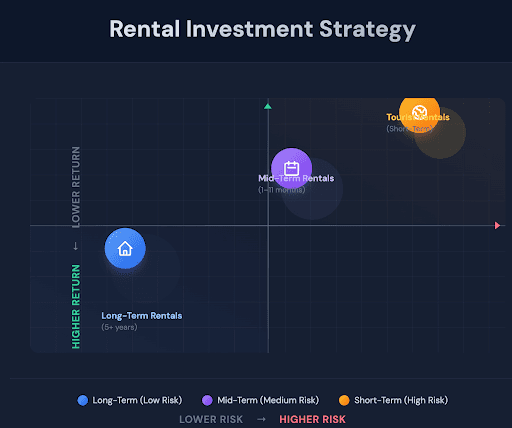
To contextualise mid-term rentals within Valencia’s broader rental landscape, the matrix below compares three main strategies.
Vertical axis: Return potential (low to high)
Horizontal axis: Regulatory and operational risk (low to high)
Strategic interpretation
Strategy | Return Potential | Risk Profile | Best Suited For |
Long-term rental | Lower but stable | Low | Conservative investors |
Mid-term rental | Strong and consistent | Moderate | Balanced income strategy |
Tourist rental | Highest potential | Highest regulatory and operational risk | High-volatility approach |
Demand drivers supporting mid-term growth
The growth of mid-term rentals is demand-led.
Remote professionals
Valencia continues to attract professionals seeking temporary relocation. Defined contract periods of three to nine months align well with mid-term structures.
International students and researchers
University-linked demand supports occupancy, particularly in well-connected districts.
Corporate relocations
Employer-backed tenants reduce default risk and provide predictable contract timelines.
Prospective buyers
Some investors rent before committing to a purchase, adding financially stable demand to the segment.
This diversified tenant profile reduces exposure to seasonal tourism cycles.
Location strategy: where mid-term rentals perform best
Location remains decisive for performance.
Poblats Marítims: strong demand due to beach proximity and urban infrastructure
Quatre Carreres: modern developments and proximity to the City of Arts and Sciences
Jesús and Patraix: competitive entry prices and good connectivity
Benimaclet: academic demand and transport access
Two-bedroom units between 60 and 100 square metres remain the most versatile asset type, balancing tenant appeal and resale liquidity.
Operational considerations and risk management
Mid-term rentals require:
Proper legal structuring
Clear temporary justification
High furnishing standards
Efficient tenant sourcing
Management fees for long-term rentals typically range between 8–12% . Mid-term rentals may require slightly higher coordination due to turnover, but remain less intensive than short-term tourist models.
Currency fluctuations and European economic conditions may influence 2026 demand, yet Valencia’s diversified international base reduces concentration risk.
Conclusion
Valencia entered 2025 with sustained pricing levels following 20% annual growth in 2024 and a 30% contraction in available housing stock during the preceding period . Rental yields around 8%, with some districts reaching 8–11%, continue to underpin income-focused strategies .
As regulation tightens in the tourist rental segment and supply remains constrained, mid-term rentals are emerging as a structurally aligned strategy heading into 2026. They provide a balance between compliance, stable occupancy and competitive yield performance within the evolving Comunidad Valenciana housing market.
At Homely, we support investors end to end, from identifying and acquiring the right property to structuring and managing mid-term rentals for new owners. We specialise in mid-term strategies, supported by our extensive expat network and established tenant database, enabling a smooth transition from purchase to income.
If you would like to explore the opportunities, best-performing areas and a strategy tailored to your objectives, book a call with our team and let’s discuss your next move in Valencia.