
Buying Property in Valencia
Off-plan property investment in Valencia has become more prominent as developers respond to a persistent housing shortage. For international buyers, these projects offer modern specifications and structured payment plans. However, in 2026, the reality is more complex.
Property prices have continued to rise, with Valencia reaching around 3,300 €/m² in early 2026, reflecting strong demand and limited supply. At the same time, new housing delivery is increasingly influenced by affordability policies and protected housing schemes. As a result, off-plan is no longer defined by discounted entry prices, but by product quality, location, and long-term positioning.

What buying off-plan means in Valencia
Buying off-plan involves purchasing a property before construction is completed, typically through staged payments to a developer.
In Valencia, most developments are located in expansion districts or areas with available land, as central supply remains limited. This includes both city districts and nearby metropolitan zones.
The model has become more common due to structural supply shortages. Housing availability has declined significantly while demand continues to grow, creating a market where new developments play an important role in overall supply .
For buyers, off-plan is often one of the few ways to access modern, energy-efficient housing stock.
Market context in 2026: supply, pricing, and VPO
The Valencia property market in 2026 is defined by a structural imbalance between supply and demand.
Prices have risen sharply in recent years, with average asking prices now exceeding 3,300 €/m², placing new-build properties close to market peaks rather than below them. This changes the traditional logic of off-plan investment, where early buyers previously benefited from discounted pricing.
At the same time, a growing share of new developments includes Vivienda de Protección Oficial (VPO) or affordable housing. Public-private projects across areas such as Malilla (Quatre Carrers) illustrate how part of the development pipeline is now directed towards regulated housing rather than open-market sales.
While foreigners are not formally excluded from VPO, the eligibility criteria significantly limit access. Buyers must typically use the property as their primary residence, meet income thresholds, and not own other property. In practice, this means that most expat investors will not qualify.
As a result, part of the new-build supply is effectively unavailable to international buyers, while the remaining private developments are launched at current market prices.
This creates a more selective environment. Off-plan opportunities still exist, but they are no longer driven by price advantage alone.
The advantages of off-plan property
Off-plan purchases continue to offer several structural advantages, particularly for international buyers.
The staged payment model allows capital to be deployed gradually rather than upfront, improving liquidity management.
New-build properties provide access to modern housing stock, which remains limited in Valencia. Many resale properties require renovation, whereas off-plan units are delivered with updated layouts, energy efficiency, and compliance with current building standards.
A key feature of recent developments is the inclusion of shared amenities, which were less common in Valencia’s older housing stock. Many new-build projects now offer facilities such as swimming pools, gyms, coworking spaces, landscaped gardens, and communal terraces. These features are designed to increase appeal for both residents and tenants, particularly younger professionals and international renters.
However, these amenities also influence pricing and ongoing costs. While they can support rental demand and tenant retention, they typically come with higher community fees and do not always translate into proportionally higher rental yields.
Maintenance requirements are typically lower in the short term, making new builds easier to manage remotely.
In some locations, off-plan developments may also benefit from gradual neighbourhood improvement. However, this tends to be a long-term effect rather than immediate price growth.
Key risks in the current market
In 2026, the risks associated with off-plan investment are more pronounced and should be carefully considered.
Pricing is one of the main concerns. Many developments are launched at levels close to current market highs, which limits short-term capital appreciation. In some cases, resale properties in established areas offer better value per square metre.
Construction delays remain a practical risk. Administrative processes, labour shortages, and rising construction costs can extend delivery timelines.
Regulatory uncertainty is also increasing. Housing affordability has become a policy priority, and future measures may affect rental strategies or investor returns.
Another important consideration is the quality of finishes and the handover process. In Spain, the final standard of a property at completion can differ from what international buyers may expect based on experience in their home countries. While new-builds comply with legal and technical requirements, finishes are often delivered at a more basic level unless upgrades are specified.
At the point of handover (escritura and entrega), it is common for buyers to identify minor defects or unfinished details, known as snagging. These may include issues with paintwork, carpentry, fittings, or alignment. While developers are obliged to address defects, the process can take time and may require follow-up.
For foreign buyers, this makes independent inspection before completion particularly important. Reviewing the specification in detail and understanding exactly what is included, rather than relying on marketing materials or renders, helps avoid misunderstandings.
There is also a potential mismatch between new-build properties and rental performance. Many developments prioritise amenities and lifestyle features, which appeal to owner-occupiers but do not always translate into stronger rental yields.
Real off-plan examples in Valencia
The current off-plan market in Valencia shows how varied the new-build segment has become, both in pricing and in product type.
In Benimàmet, one of the clearer entry points is a new-build scheme on Calle Felipe Valls. Within that promotion, prices start from around €199,000 for a one-bedroom unit of approximately 67 sq m, while two-bedroom properties reach €319,000 to €329,000 for around 100 sq m, equivalent to roughly €3,100–€3,300 per sq m. The project is positioned as a managed “flex living” concept, with shared amenities such as a pool, coworking space and fitness area, and operational management included. This shifts the investment case away from traditional buy-to-let and towards a serviced model, which requires careful review of contracts and yield assumptions.

In Patraix (Safranar), the Verdana Apartments development reflects pricing in more established residential districts. Entry-level units start from around €250,000, while a typical two-bedroom property of 69 sq m is priced at approximately €309,000, or €4,478 per sq m. In addition, buyers are required to purchase a storage unit for around €10,000, increasing the effective entry cost. This example illustrates how new-build pricing in consolidated areas is already aligned with or above city averages.
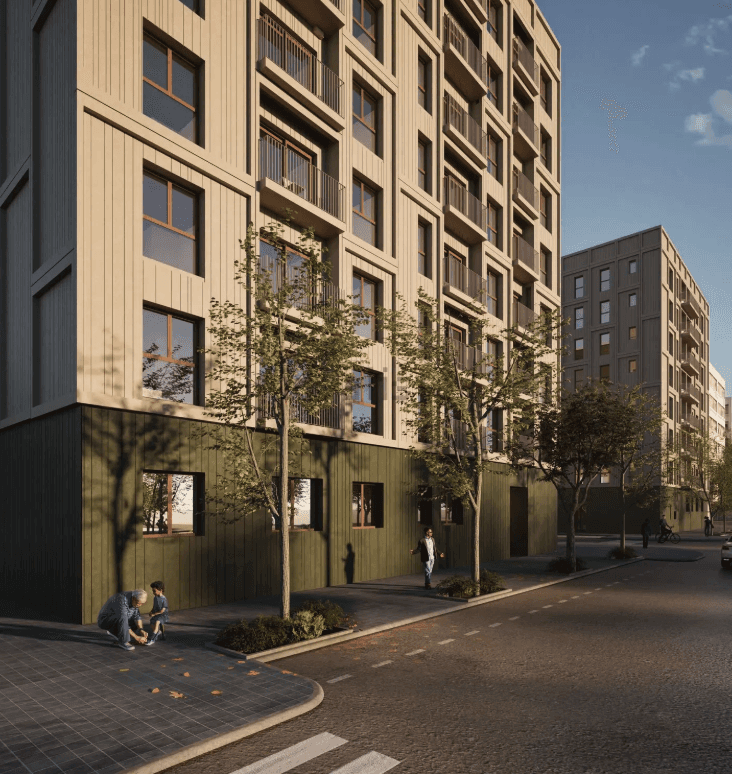
In Sant Antoni (La Saïdia), the Urban Garden Valencia project sits between these two segments. Prices begin at around €191,000 for smaller units, with two-bedroom properties such as an 84 sq m apartment at €310,000, or roughly €3,690 per sq m. The proximity to the Turia gardens and public transport supports long-term rental demand, and pricing appears more balanced relative to location.

A useful comparison comes from developments such as Residencial Moreres, located in an area of urban transformation near the coast. Here, the focus is not on entry price but on long-term quality. The project emphasises large terraces, natural light, functional layouts, and energy efficiency through aerothermal systems and solar panels, alongside high construction standards and durable materials . This reflects how developers are positioning new-build product in Valencia.
Taken together, these examples show that off-plan is now a segmented market. Some projects focus on managed rental concepts, others on owner-occupier demand, and others on long-term urban transformation. Pricing, product type, and target tenant vary significantly, meaning that entry price alone is no longer a sufficient metric for evaluating value.
Conclusion
Buying off-plan in Valencia in 2026 offers access to modern housing in a market with limited supply. It provides structured payments, updated specifications, and exposure to developing areas. However, it is no longer a low-entry or high-margin strategy.
The increasing role of VPO and affordable housing reduces the share of new-build supply available to investors. At the same time, private developments are often launched at elevated price levels, limiting short-term upside.
As a result, off-plan investments require careful selection. Location, pricing, product type, and demand fundamentals are more important than the new-build label itself. Comparing off-plan opportunities with well-located resale properties remains essential.
Valencia continues to offer strong long-term fundamentals, but the market is becoming more selective. Off-plan works best when approached as a long-term strategy with realistic expectations.
If you’re considering buying in Valencia and want personalised guidance, get in touch with our team.